Social Media · Athletes
Athlete media kit: what to include, with examples
By Ekaterina Danberg · November 2026
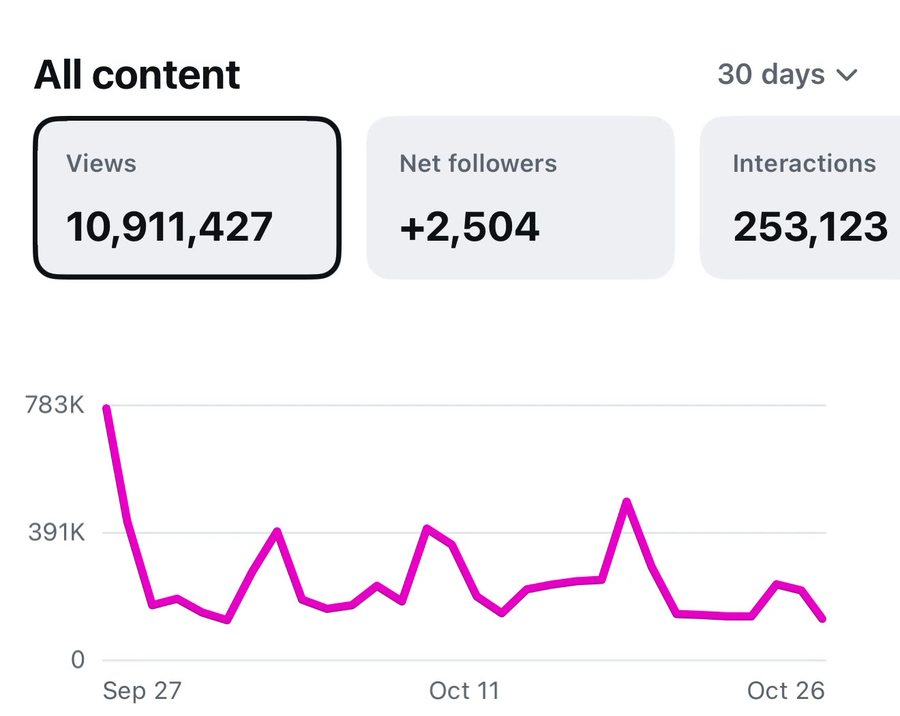
An athlete media kit needs who you are, who watches you, what an ordinary post does, which of your videos already touch a brand's category, unedited Insights screens and what you can make for them. Build it around the question a brand is really asking: where would my product already fit on this account? Leave out anything you couldn't defend on a call.
In October I built a ten-page kit for a US ballroom champion whose account I work on. I've written separately about what her Insights revealed and how to run the pitch. This page is about the document: what sits where, what I cut, and what to do about the gaps. The kit is new, so I can't yet report how many brands said yes.
The ten pages
| Page | What's on it | What it has to settle |
|---|---|---|
| 1. Cover | Name, title, discipline, three numbers, and a footnote with the source and exact dates | Who this is, in five seconds |
| 2. The athlete | Four or five sentences with a turn in them. Hers: no semi-final a year ago, national title this season | Why anyone would care |
| 3. Who watches | Gender, age bands, top countries, top languages, most active hours in the brand's time zone | Whether these are the brand's customers |
| 4. Reach | 30-day and 60-day columns side by side, where views come from, and a median line | Whether the reach is steady |
| 5. Best work | How many reels cleared 300K, 700K and 1M, then a list with date, views, likes and shares | How often it happens |
| 6 and 7. Categories | Topic by topic, the proof that each product type already performs | Where the brand goes |
| 8. Raw screens | Uncropped Insights, with an offer to send the screen recording | Whether to believe pages 1 to 7 |
| 9. What we make | A reel integration, a story set, a competition-weekend series, a how-we-do-it tutorial | What they'd actually be buying |
| 10. How we work | Who answers messages, who signs, when filming can happen, categories you won't take | Whether this will be easy to work with |
Ten pages suits an account with this much to show. If you have one good reel and 2,000 followers, keep pages 1, 3, one category and page 9 on a single sheet.
Pages 6 and 7 do the selling
When I reviewed the first draft, the numbers were fine and nothing in it told a brand what to do next. So I went through all 248 reels, tagged the topic of the 102 strongest, and turned the middle of the kit into a commercial offer under the heading "Your category is already in our feed."
Each block has the same five parts. Using the dance shoes block as an example:
- Topic: dance shoes.
- The headline reel and its public view count: 474K.
- How many reels and how many views in total: 2 reels, 787K.
- Made for: dance-shoe brands, brushes and shoe care, heel protectors, shoe bags.
- We can create: shoe-care ASMR, an unboxing and first practice, the shoes on the competition floor.
A marketing manager can find their block in seconds and picture a specific video. A sports nutrition company reading a swimmer's kit should reach "post-session recovery" and see a reel, a number and a concept. If a category has no reel behind it, leave it out for now and film one.
What I took out, and why
A strip of brands already tagged
It looked good in the draft. Those tags were product exchanges, and a line like that invites a brand to ask for campaign results that don't exist. If your tags are gifts, say so or leave them out.
A 388K reel with 24 likes
Views and likes that far apart make a careful reader wonder where the views came from. I didn't have an answer, so it isn't in the kit.
An exact count of million-view reels
Public counters and Insights gave different totals, because Insights adds Facebook views from cross-posting. I kept the Insights count on the page where its source is labeled and wrote loosely everywhere else. If a brand checks your counters and finds a smaller number than your headline, you've lost them.
Double-counted hits
Two of the biggest reels on the account had the same covers as earlier reels and looked like re-uploads. Re-posting is normal. Presenting a re-upload as a separate success isn't, so don't add such pairs together when you total a category.
Photos pulled from the grid
Screenshots of your own feed look soft in a PDF. Ask whoever shoots your events for originals: action, close-ups of whatever you'd sell, and one ordinary photo of you in normal clothes.
Fix these numbers before you send it
- A median. Instagram's lists show your winners, and a marketing manager wants to know what a normal reel does. List your last 15 to 30 reels by date, sort them by views and take the middle one. On our first draft this line was still blank, and it was the first thing I asked for.
- Engagement divided by views when most views come from non-followers.
- Dates on every figure. Dates on the file name, too.
- Audience by country, set against the country the brand sells in.
- Age bands. Ours took whole product categories off the list before any email was written.
- A clear label wherever a number includes another platform.
- An email address someone checks.
PDF, web page, or both
I made both. The PDF is what gets forwarded to the person who controls the budget, and it needs to work with no one around to explain it. The web version can carry reels that play, which matters a lot in a sport where the product is movement.
The in-app file previews on phones, such as in messaging apps and the iPhone Files app, don't run scripts, which I ran into on this kit. Anything that depends on animation can sit blank or frozen, so make sure every number is readable with the scripts off. And keep your rates on a separate sheet, sent once someone asks, so you can change them without reissuing the kit.
Questions I get about it
- Is there a template I can copy?
- Take the table above as your template. Most downloadable ones ask for engagement per follower and a list of past partners, and either can hurt you if the honest answer is small or doesn't apply.
- How often should it be updated?
- Before every round of pitches, and at least once a quarter in season. Put the month on the cover so nobody has to guess.
- Should my competition results go first?
- One line on the cover and a short story on page 2. A brand needs to know you're credible, and after that it's buying your audience.
- What if my numbers are small?
- Then lead with fit and precision: a narrow audience in one country, a topic that keeps getting saved. I'd take a modest kit that holds up over a big one with no median.
Getting an account to the point where these pages fill themselves is the account growth work I do.