AI Films · AI for brands
AI jewelry ads: what works on metal and stones
By Ekaterina Danberg · November 2026
AI video works for jewelry when each shot gives the model one readable object, light that moves for a stated reason, and a real product photo to match. In my work so far polished metal and large step-cut stones hold up well, while fine pavé and swinging chains need more testing. Every frame has to be checked against the original, because a changed stone is a false ad.
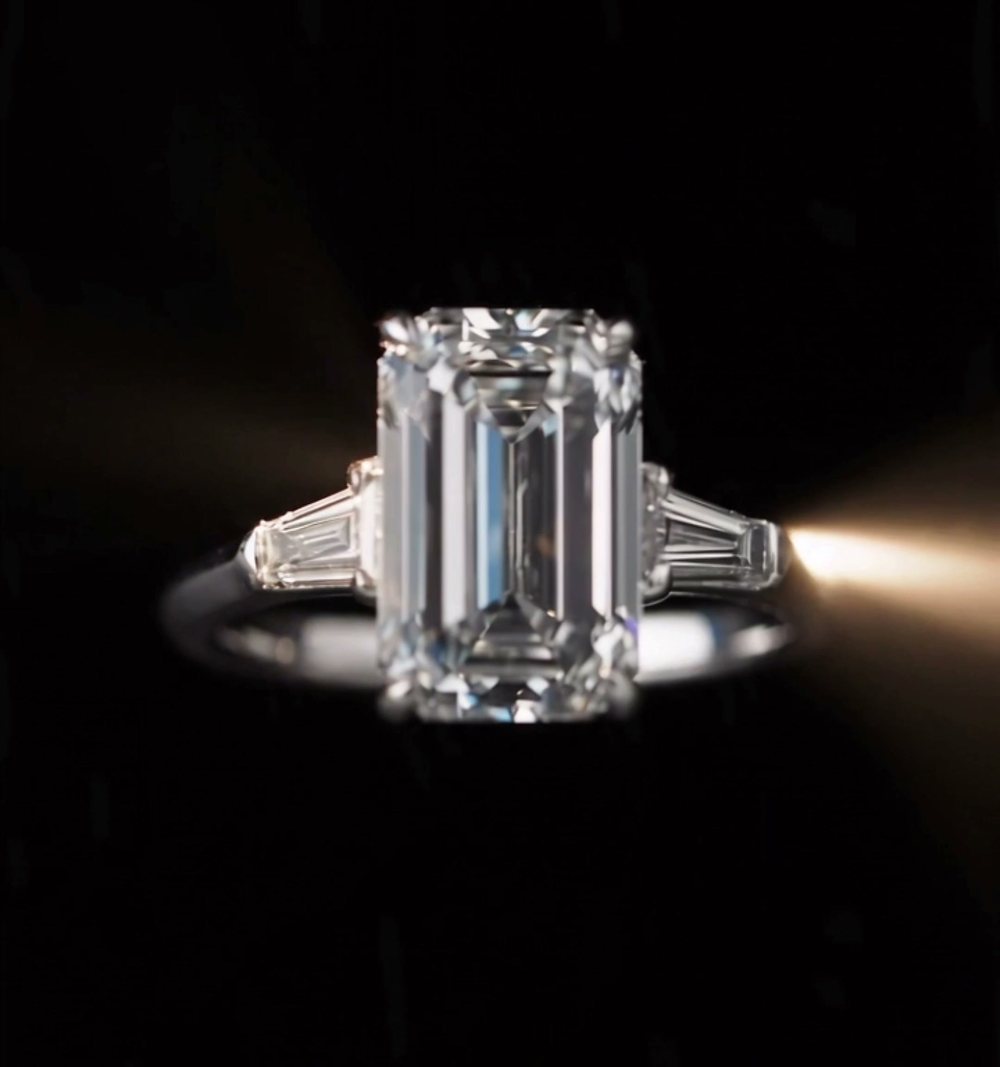
The frames on this page come from an AI jewelry ad I directed: an emerald-cut ring with tapered baguettes, matching drop earrings and a bracelet. It cuts between a dark macro, a hand, a lapel and a portrait. Here's what I'd tell a brand about each material before we start, including where the method is still weak.
Metal: the light needs a reason to move
Polished metal is mostly a mirror of the room, so it looks wrong the moment a reflection does something that room wouldn't. I write where the light comes from and which surfaces it crosses, by name: the shank, the prong tips, the shoulder of the setting. In this ad a warm bar of light lies across the neck and lapel, and I judged the metal against that one source.
Two things I learned on other projects carry straight over. Generators carry out what you name, and they overdo it. On one of my projects a prompt asked for a single wisp of smoke from one candle, and every candle came back smoking. So words like flash, flare and pulse stay out of the description of a metal shot and go only in the list of things to avoid. The opposite failure comes from cautious wording. "Tiny," "very slightly" and "perfectly still" read as an instruction to do nothing, and the clip comes back as a photograph. I give the movement a visible size and a physical cause instead.
Step-cut stones: count the lines
Emerald and baguette cuts have long, parallel facets. That makes them good subjects for AI video, because the geometry reads clearly, and harsh ones, because a single wandering line is visible even on a phone. I freeze the clip and compare it with the reference at full size. I look at the cut corners, the number of steps, the proportion of length to width and which way the baguettes taper. A step that disappears for three frames is grounds to reject the take.
Round brilliants are more forgiving about facets, since nobody can count them at reel size, and less forgiving about fire, the flashes of color that make the stone look alive. I haven't shot a brilliant-cut hero yet, so treat that as how I'd approach it.
Pavé and small stones
Luma, which sells AI video tools, names gemstone refraction, sparkle and chain movement as challenges "where most generators fail." That's a vendor's statement with no test behind it, and it matches what I'd plan for. On a pavé band I'd use a real macro photograph as the reference, and keep the pavé small in the frame so it reads as texture. In this ad the diamond-set hook of the earrings is never the subject of a shot.
Chains, drops and anything that swings
Movement on a hanging piece needs a cause in the prompt: a head turning, a step, a hand brushing past. Count also breaks more easily than you'd expect. On another film, a character holding one object in both hands came back with one in each hand. A pair of earrings carries the same risk, so I write the exact count and which ear each one is on. In this ad the bracelet appears only at the edge of a few frames. I'd run a test on a swinging chain before promising one to a client.
Hands, skin and scale
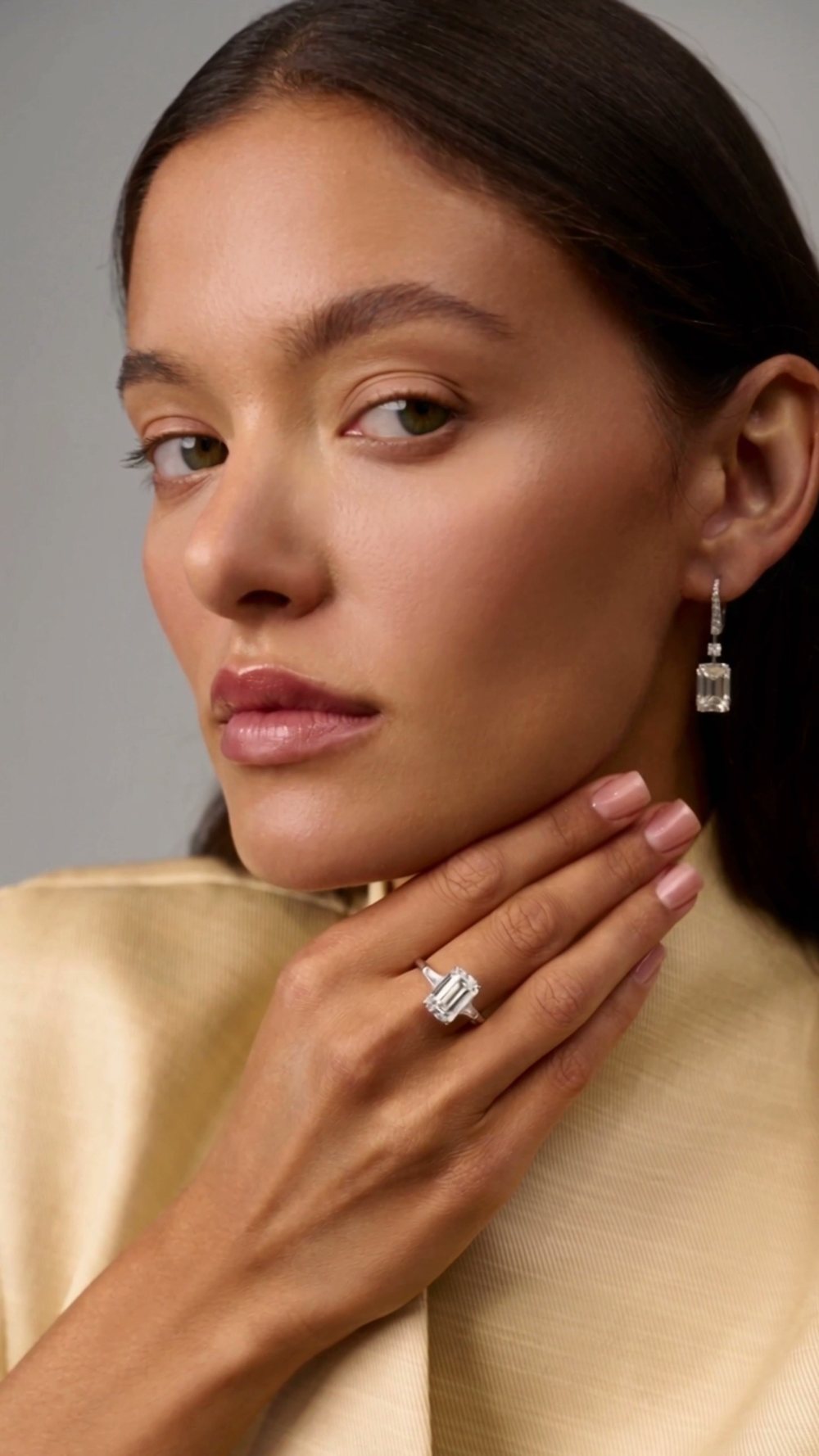
A ring only convinces when its size agrees with the finger, and scale can drift between cuts. I compare stone width against finger width from shot to shot. For skin and materials, the first block of every prompt describes a real lens, real materials and no invisible fill light. Without it, things come out plastic. I threw out an early version of a film for exactly that, and for being one flat, static take.
That second problem matters as much for a ring. A single 15-second take of a piece on a hand is the easiest thing to generate, and it looks like it. I plan four or five shots per 15 seconds, each at its own scale, with something soft in the foreground when the scene allows it.
If you want this done on your own pieces, that's the AI film work I take on.
What goes wrong and what I do about it
| What goes wrong | What I check | What I do |
|---|---|---|
| The stone changes shape between cuts | Corners, step lines and proportions against the reference | Regenerate from the approved still |
| An extra or missing prong or side stone | A count at full size | Reject the take, because retouching it would change the product |
| Metal color drifts | Side by side with the product photo | Reject, or correct if the shift is uniform |
| The first frame doesn't match the still | Frame 0 against the source image | Catch it before watching the rest |
| Sparkle on everything | The prompt, for words like flash and flare | Remove them and describe the light path |
| The clip is a frozen photo | The prompt, for soft words | State a visible movement and its cause |
| Upscaling damages the facets | Facet edges before and after | Test on a highlight shot before running the whole ad |
What I need from a brand
Photos of each piece on a neutral background, two to four angles per piece. Too few angles, a colored background or blown highlights all cost you accuracy later, so I say so before we begin and we agree what to reshoot. Then you see three to five test frames and the script, and nothing moves forward until those are approved. In production, every frame gets compared with the original piece for shape, stones and metal color.
The rules that apply to jewelry
This is general information and not legal advice. The FTC's Jewelry Guides call it deceptive to misrepresent an item's size, weight, cut, color or any other material aspect. An AI shot that makes a stone bigger or cleaner than the one you sell is that kind of misrepresentation, whatever tool produced it. If you sell lab-grown or simulated stones, the disclosure belongs near the product claim. The FTC's 2019 warning letters to eight jewelry marketers flagged online ads that didn't put it there.
If the ad runs in New York and a generated person appears in it, General Business Law section 396-b requires a conspicuous disclosure of the synthetic performer when the advertiser knows one is there. It applies in any medium where the ad appears, and it carries civil penalties.
Common mistakes
- Approving the mood and never checking the piece against the original.
- Sending one flat catalog photo and expecting a turn around the stone. The model will invent the side you didn't show.
- Asking for "more sparkle" in revisions. Say which shot and which surface.
- Using AI for the product detail page. A shopper studying a stone before buying should see a photograph.
- Assuming the file is the resolution you paid for. I've been billed for 1080p and received 720p, so I check every file.
FAQ
- Can AI reproduce my exact piece?
- Often enough for campaign shots, once each frame has been compared with the original. Anything that differs gets rejected or redone. Close-ups of complex settings are the hardest part.
- Do I still need a photo shoot?
- You need product photos, two to four angles per piece on a neutral background. You don't need a model, a location or a film crew.
- Do I have to label an AI jewelry ad?
- It depends where it runs and what's in it. New York's rule covers synthetic performers, and platforms have their own policies that change often. Check them for each campaign.