AI Films · AI for brands
AI video for hotels
By Ekaterina Danberg · November 2026
AI video belongs in a hotel's storytelling: a film about the building's past, a seasonal mood piece, a looping screen in the lobby. Rooms, pools, views and anything else a guest books should be real footage, because platforms ban misrepresentation and guests compare on arrival. I haven't worked with a hotel, so this is how I'd approach it.
Travelers are already being misled by this
In October 2026 a US TV investigation compared AI travel videos on TikTok with the real listings. One video gave a Gaylord resort a lazy river it doesn't have, by combining features from several properties. Another showed a kitchen opening onto a bedroom where the listing showed that opening leads outside. Those were commission accounts and not the hotels themselves, but a guest who arrives expecting the lazy river complains at your front desk.
Invented places hurt the neighbors too. In 2025 a Tasmanian tour site published an AI article and pictures of hot springs that don't exist, and the nearby pub took repeated calls from people trying to find them.
What platforms and regulators already say
This is general information and not legal advice. Expedia Group's partner content policy prohibits content "that uses generative AI or AI editing tools to mislead, misrepresent, or fabricate information," including to misrepresent a property. Booking.com's content guidelines bar "AI-generated content that is misleading or deceptive" and images that don't relate to the actual travel experience.
Advertising regulators got here before generators did. In 2013 the UK's ASA upheld a complaint over a generic photo of a building in Malta, because consumers would assume it showed the hotel being sold. In 2018 it ruled against a hotel company whose site mostly showed a mansion house while some rooms were in a separate building. Neither case involved AI. Both turned on what a guest would reasonably assume from the picture, and that's the test I'd apply to a generated shot. In the EU, Article 50(4) of the EU AI Act, applicable since August 2, 2026, also reaches AI content resembling real places that would falsely appear authentic.
Placement by placement
| Where it runs | What goes in it | AI's role |
|---|---|---|
| OTA galleries | Real footage and photos only | Color and exposure at most |
| Room pages on your own site | A real clip per room category | Titles and transitions |
| Google listing | Real only | None |
| Paid social | Real rooms, with an opener that is plainly a story | The opener, disclosed where required |
| Organic brand films | The building's history, the founder, a local legend | Most of it, as long as the history is true |
| Lobby and in-room screens | Art, seasonal scenes, a slow looping world | All of it. These guests have already arrived |
| Before opening | Renders of the rooms, labeled, with the opening date | The main tool, replaced as soon as real rooms exist |
Before opening is the strongest case. You have a building site, a sales team and nothing to film, and a labeled film built from your approved plans can carry that gap honestly.
The things hotels will be tempted to fix
- A sea view from a room category that has a partial sea view.
- The road between the hotel and the beach, which disappears in a clever cut.
- The annex rooms, which never appear next to the main building.
- A full terrace in a month when the terrace is closed.
- Generated guests, who suggest who stays with you and who would feel out of place.
- Snow or blossom on your facade, which is fine as mood if it really happens there and misleading if it's the reason someone books February.
Lobby loops have their own rules
A screen that plays for hours is where a generator is most useful to a hotel, and I've spent a lot of time on looped scenes for a long-form channel. A clip that repeats can't contain an event. I once planned a gust of wind arriving, peaking and dying away. On a nine-second loop that's a metronome, repeated hundreds of times over three hours. What holds up is small continuous movement, out of step across the frame.
It has to be visible, though. Motion that only an instrument can detect doesn't exist for the person in the armchair, and brightness flicker on its own reads as a still picture. It also has to be the right motion. A sleeping cat in one of my winter scenes breathed about once every two seconds, and once looped it looked like a veterinary emergency. In another, snow I'd asked for outside the window fell inside the room. Averages don't catch either one. I look for them by eye before anything gets shown.
Continuity, and the people on the terrace
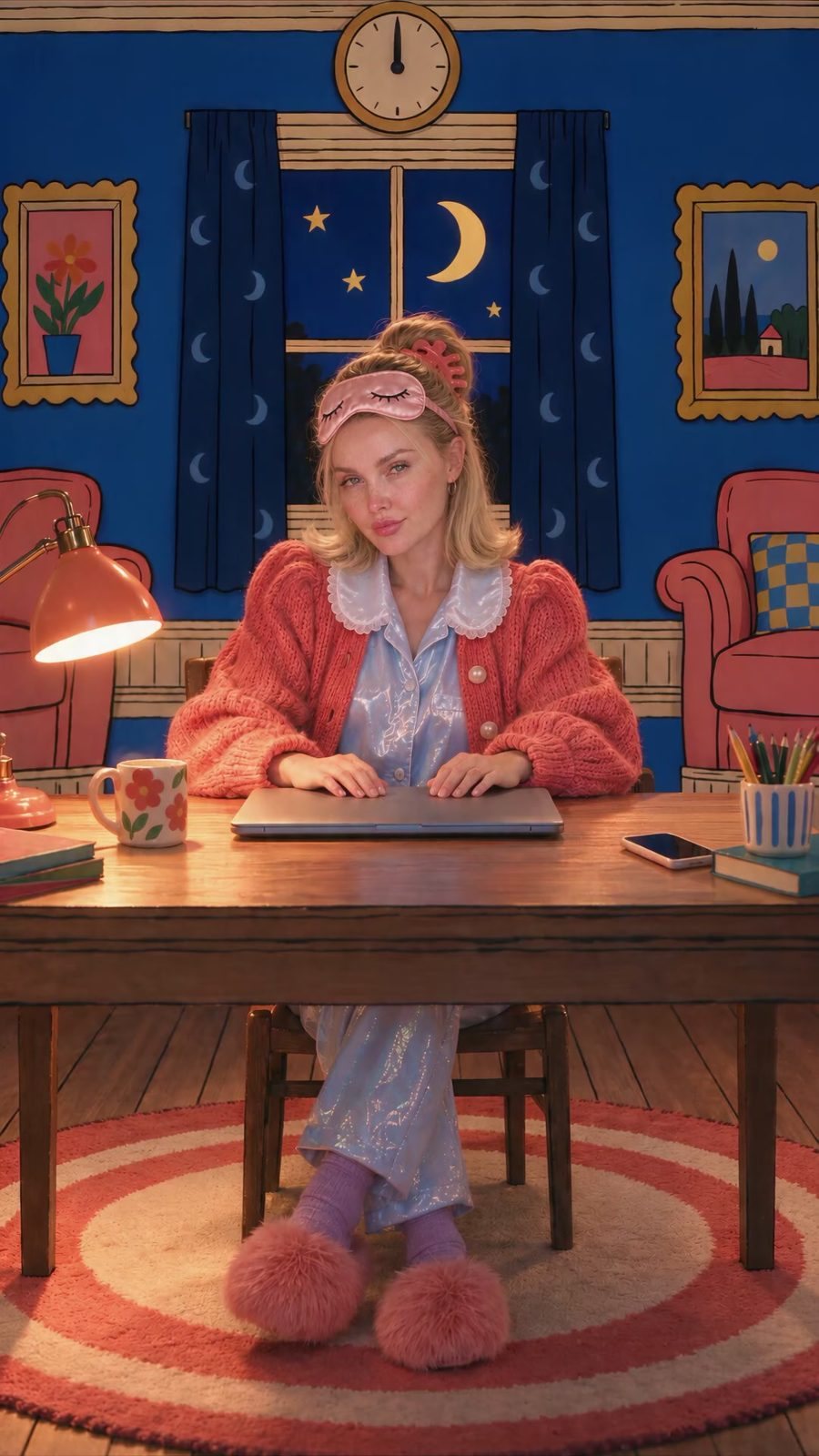
A film that returns to the same suite needs it to stay the same room. On that promo, the clock in the empty set and the clock in the frame with the character turned out to be two different clocks, and I only saw it when I cropped them side by side. So before a series of frames in one location I list what changes through the story and what stays fixed: bed runner, lamp, the sky in the window, how many cups are on the table. For a hotel I'd add room numbers, key cards and uniforms.
Scale matters more than people expect. On one film I made the characters tiny, their faces came out about 25 pixels wide, and the model drew toys. People on a far terrace in a wide shot go the same way. I'd bring them closer or leave them out.
One real shooting day, in order
- Sunrise: facade, terrace and the pool before the loungers go out.
- After checkout: one room per category, made up by housekeeping to your real standard.
- Late morning: the restaurant during prep, and breakfast laid out before it opens.
- Golden hour: the view from the actual windows of each category you sell by view.
- Evening: lobby and bar. Guests in frame sign a release or stay out of it.
That day's footage goes on every page where someone is deciding to book. The generated work then has a place of its own in the brand films and on the screens, and that's the AI film work I'd do with you. I'd measure it against direct bookings and search your reviews for phrases like "not like the video." I can't give you hotel numbers of my own.
What I'd ask you to send
- Room categories with floor plans and sizes.
- Current photos of each category, and your photographer's license. Check it covers edits and derivative work, because many hotels don't own their images outright.
- Archive material with dates, if we're telling the building's history.
- Brand book, uniforms, signage files and room-number style.
- A list of what closes seasonally.
- Links to your live listings, so I can compare the film against what guests are promised.
- One person who can sign off on accuracy.
What travelers catch
- A king bed that turns into a double in the next shot.
- A balcony railing with a different pattern on each floor.
- Sea on a horizon that isn't level.
- Bathroom mirrors reflecting another room, or nothing.
- Breakfast dishes melting into one another along the buffet.
- Elevator buttons and door signs in invented letters.